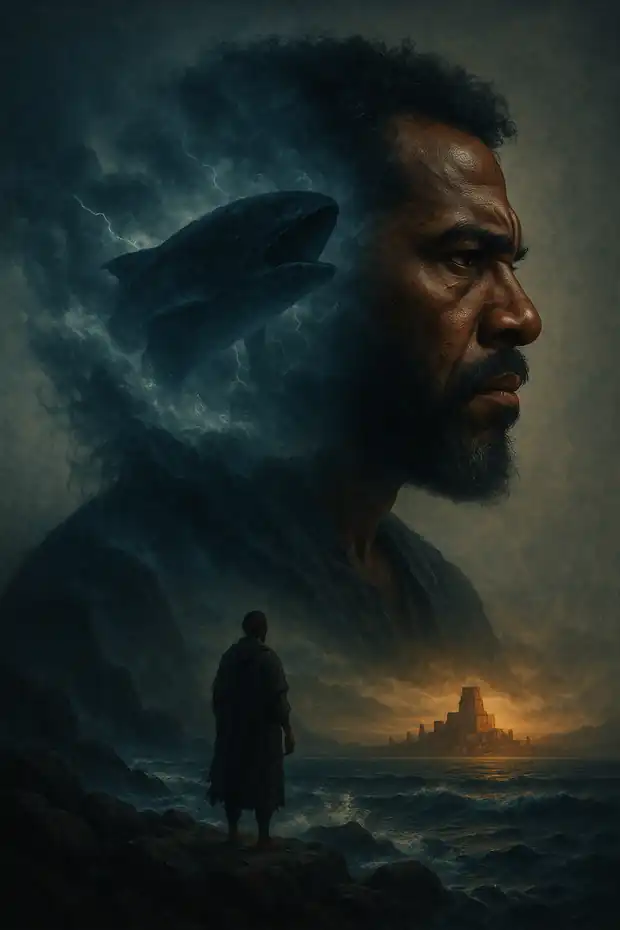
A Bible Study Series · Bethesda Christian Ministries
JONAH
The prophet did not run from a city.
He ran from a God who was too merciful.
A Bible Study Series · Bethesda Christian Ministries
The prophet did not run from a city.
He ran from a God who was too merciful.
The Series
Jonah is the shortest prophetic book most people think they know. A man is told to preach. He runs. A fish swallows him. He preaches. The city repents. Children's ministry has been telling it that way for a hundred years, and in the telling it has been shrunk down to a lesson about obedience.
It is not a story about obedience. It is a story about a devout, orthodox, theologically correct man who could not stomach the mercy of the God he served. Every other character in the book gets it right. Pagan sailors pray. A violent empire repents. A plant, a worm, and a wind all obey on cue. The only creature in the entire narrative that resists God is the prophet.
That is the point. Jonah was written to be read by insiders. It ends without resolution, on a question God asks Jonah and never answers, because the question was never really for Jonah.
The Big Idea
The greatest threat to faith is not the wickedness of the world, but the distorted worldviews we allow to take us captive, even inside the church. God calls us, like Jonah, to confront deception with truth, mercy, and obedience rather than fear and tradition.
"When religion speaks without compassion, its message becomes an empty echo of the world's deceit."Abraham Joshua Heschel
Jonah 1 · Colossians 2:8
Paul warned a church about being taken captive by empty deceit. Jonah is that warning in narrative form — a prophet held hostage by his own tradition, sent into an empire held hostage by its own.
Read the notes → IIJonah 1:17 – 2:10
The fish was never the punishment. It was the intervention. A study for anyone who has known what it feels like to want to quit, to disappear, to stop caring what happens next.
Read the notes → IIIJonah 3 – 4
Eight Hebrew words toppled an empire. Not because the sermon was good, but because God had been working the room long before the preacher arrived — and used the preacher's worst chapter as the proof.
Read the notes →Episode One
Paul writes to a small congregation in the Lycus valley and says: Colossians 2:8. Watch out, he says, or someone will carry your mind off as plunder. The Greek word he uses, sylagogon, is not the language of a debate. It is the language of a kidnapping.
Now read Jonah with that word in your hand. Jonah's world is shaped by the most powerful philosophy of the ancient Near East: Assyrian supremacy, a national ideology backed by brutal violence, pagan religion, and imperial propaganda. And Jonah's own heart is shaped by a mirror image of it — a national ideology of his own, backed by inherited assumptions about who deserves grace.
Both Paul and Jonah confront a world where ideology masquerades as truth. Paul exposes deceptive systems that enslave the mind. Jonah is sent to a city discipled by a violent worldview that enslaves an entire civilization. Paul gives the diagnosis. Jonah is sent into the disease.
Jonah is not fleeing because he's scared of Nineveh. He's fleeing because he's scared of God's mercy.
The atrocity is never the first step. Before a civilization commits violence, it submits to a worldview that teaches it what to fear, what to worship, and what to hate. Assyria did not wake up one morning and invent cruelty. It was catechized into it — by its temples, its royal annals, its victory reliefs, its omens.
Scripture insists that any foundation not rooted in God leads to destruction, whether that foundation is intellectual (Greek philosophy), traditional (distorted religious inheritance), or cosmic (the elemental spirits). The category changes. The captivity does not.
This is why Jonah and Colossians belong together. Jonah becomes God's instrument to confront a deceptive civilization; Paul confronts deceptive doctrine inside the church. Same enemy, two fronts.
Jonah is the prophet running from God. The Colossians are believers drifting from Him. Different postures, identical problem.
Jonah is held captive by:
Human tradition told Jonah: Assyria is irredeemable. They deserve judgment, not mercy. God tells Jonah: I have compassion even for people you hate. Jonah is the embodiment of Colossians 2:8 — the prophet himself taken captive by a tradition that distorts God's heart.
Paul's phrase "the elemental spirits of the world" points to cosmic powers that animate false worldviews. Jonah's Nineveh is not merely wicked. It is spiritually animated:
Jonah is one of the most cosmic stories in the Old Testament, and not because of the fish. It is cosmic because a single prophet is dropped into an entire worldview empowered by spiritual darkness. Paul warns about the unseen forces that shape a culture. Jonah is sent into a city fully shaped by them.
Nineveh was built on deceit: the deceit of strength, of invincibility, of violence, of imperial ideology, of false gods. God's response to a deceived world is not annihilation. It is a preacher.
Confront the deception. Call people back to truth. Offer mercy before judgment. That is the pattern, and it is the same pattern in both books. Jonah is the Old Testament's Colossians: it shows what happens when a deceived world encounters God — and when a deceived prophet encounters Him too.
Paul attacks tradition disconnected from Christ. Jonah embodies tradition disconnected from compassion. Colossians describes the theological problem; Jonah is the narrative embodiment of it.
Set the two populations of the book side by side and the result is scandalous: Jonah has correct theology and the wrong heart. Nineveh has the wrong theology and the right heart when confronted with truth. Which one ends the chapter aligned with God? The repentant empire, not the resistant prophet.
Jonah is a mirror for Christians who use theology as a shield against the people God loves.
Colossians culminates in the supremacy of Christ. Jonah culminates in God's mercy toward the unlikeliest people. Both land in the same place:
The heart of God cannot be confined by human categories or traditions.
The Core Problem
Jonah is not rebellious because he hates God. Jonah is rebellious because he loves his religion, his national identity, and his own sense of justice more than he loves the heart of God.
His version of empty deceit was not paganism. It was the belief that God should never forgive people he despised. And that is precisely why he says the most chilling line in the book: Jonah 4:1–4. I knew that You are gracious and merciful — therefore I fled.
Jonah ran because God was too good. His religion could not tolerate a God this merciful. That is religious captivity, and it does not require a single false doctrine to take hold.
"God loves us, but not those people." The line gets drawn, then defended, then eventually mistaken for Scripture itself. Jonah did not invent his line; he inherited it, and it was reinforced every time an Assyrian army crossed a border.
Jonah preferred correct doctrine over correct heart posture. He loved being right more than he loved being righteous. The two feel identical from the inside, which is exactly what makes this so dangerous.
If Nineveh repents, Jonah loses his sense of moral superiority. His identity has been built on the opposite side of a war, and peace would cost him himself.
Many Christians today cling to political enemies, cultural enemies, gender or racial enemies, theological enemies — because their identity depends on being on the right side of a war God never asked them to fight.
When God becomes a mascot for my worldview, I am no longer worshiping God. I am worshiping myself with Bible verses attached.
Most Christians were never taught the difference, because they were raised in structures where the two were blended. But Scripture draws a sharp line. Religion is the system we build around God. Faith is the surrender we give to God.
The dividing wall is not a metaphor the study invented. It is precisely what Paul says Jesus came to destroy — Ephesians 2:14.
None of this is an argument against structure. Healthy religion is scaffolding that helps faith grow: community, Scripture, sacraments, worship, accountability. Jonah's problem was never that he had a tradition. Every faithful person does.
But even good religion becomes idolatry when it becomes the source of identity instead of God; when it becomes a weapon instead of a mirror; when it protects our biases instead of exposing them; when it cages the Holy Spirit instead of hosting Him.
Jonah's religion was sound in theology but sick in spirit.
The book ends with a question: "And should not I pity Nineveh?" In Hebrew this is a rhetorical thunderclap. God is asking: Do you want me to stop being Myself just to fit your theology? Do you want religion… or do you want Me?
Episode Two
"When we are no longer able to change a situation, we are challenged to change ourselves."Viktor E. Frankl
When most preachers talk about Jonah, the fish becomes the villain. We imagine Jonah being swallowed as discipline, as punishment, as divine anger. That is a misreading rooted in surface-level religion — the kind that wants a quick moral instead of honest humanity.
Slow down and read Jonah the way the ancient community would have heard it, and something else rises to the surface. Jonah wasn't terrified of the fish. Jonah was terrified of obedience.
The fish wasn't judgment. It was God saving Jonah from Jonah.
His actions make it painfully clear. He runs from God intentionally (Jonah 1:1–3) — he isn't ignorant, he isn't confused, he is deliberately sprinting the opposite direction. This is the behavior of a wounded prophet, not merely a rebellious one.
He sleeps through a deadly storm (Jonah 1:5). This is not normal sleep. It is shutdown sleep — the sleep of burnout, of hopelessness, of a man whose system has stopped responding. The Hebrew radam carries the sense of a deep, unnatural sleep. It is the silence of Psalm 88. It is the avoidance of emotional pain.
Then he asks the sailors to throw him into the sea (Jonah 1:12). He would rather drown than deal with God.
Jonah wasn't just rebellious. He was done. Burned out, disillusioned, angry at God, angry at ministry, angry at himself. He wanted oblivion, not redemption.
So when God sends the fish (Jonah 1:17), the fish isn't punishment. The fish is a rescue mission. The fish is mercy. The fish is an intervention. The fish is the therapy room where God detoxes Jonah from self-destruction.
It is the Psalm 139 moment. If I make my bed in Sheol, you are there. The one place Jonah chose specifically because he believed God would not follow him turns out to be occupied.
The fish is like a baptism. He goes down into the waters — the underworld, chaos, death — and comes up three days later, reborn. It is the foreshadowing of Jesus; Jonah experiences a resurrection in miniature (Matthew 12:39–41).
The fish is a divine interruption. Jonah planned his death. God interrupted his plan. Sometimes grace looks like God ruining your exit strategy.
When horrible things happen to you in life, don't immediately assume you are being punished. Consider that God may be slowing you down to give you space to reconnect with Him.
Jonah's prayer is not poetic praise. It is the sound of a man waking up from emotional numbness. He admits he is drowning. He admits he is desperate. He admits God is his only hope.
The language mirrors the deep lament of Psalm 88, the one psalm that ends in darkness. Jonah is not healed yet — but he is honest for the first time in the book. And honesty is the first miracle. When we are honest with God about our pain and disappointments, real miracles can break forth from wherever we are.
Watch the turn: Jonah shifts from let me drown to "I remembered the LORD." He is still broken. Still fragile. But he is breathing again. And the fish releases him the moment his heart softens.
Liberation theology is a Christian movement teaching that God is always working to free people from anything that crushes their dignity, destroys their hope, or holds them captive — whether that captivity is external (oppression, injustice, poverty) or internal (despair, self-hatred, spiritual burnout).
It reads Scripture through the eyes of the suffering and insists that God does not abandon people in their lowest places. Instead, He enters those places, confronts what harms them, and leads them toward freedom and wholeness.
This ties directly to Jonah. Jonah wasn't liberated from Nineveh. He was liberated from himself. God enters his darkness, disrupts his self-destruction, and pulls him toward healing.
1. God intervenes when we spiral. When thoughts turn dark and hopeless, God has a way of sending something — a person, a pause, a crisis, a closed door, a fish. His interruptions are mercy.
2. God will put you where you finally hear Him. When distractions fall away, His voice becomes clear.
3. Some confinements are holy. The job loss that slowed you down. The illness that forced you to rest. The breakup that saved you from worse heartbreak. The burnout that made you reevaluate everything. These are belly moments.
4. God fights for you even when you have stopped fighting for yourself. Jonah gave up. God didn't. This is liberation theology in its purest meaning — God intervenes to save the oppressed, even when the oppressed are oppressing themselves through despair.
5. The fish teaches the difference between religion and faith. The fish that swallows you was sent on purpose. The fish is grace. The fish is spiritual defibrillation. And if you allow it, it can lead to repentance and resurrection.
This episode names something the book of Jonah names first: a servant of God so exhausted that he asked to be thrown into the sea. If any of that description fits where you are right now, please do not carry it alone. Talk to one of the pastors, or to someone you trust, this week. Bethesda is a safe place to say it out loud, and there is no version of this study that ends with you keeping it to yourself.
Tap any beat to see where it sits in the text. Drag or scroll the row sideways.
Scroll →
Episode Three
"God doesn't call the qualified. He qualifies the called."A. W. Tozer
God's mercy is bigger than our biases, and He will use anyone — even the unwilling — to reach those He refuses to give up on.
Jonah's sermon was not eloquent. "Yet forty days, and Nineveh shall be overthrown!" No introduction. No call to repentance. No mention of God's name. No compassion. No hope. Eight words in Hebrew — five, by some counts. It is the worst evangelistic sermon in Scripture.
And a whole empire fasted, repented, and threw itself before God. Why? Because Jonah's power was never in Jonah. The power was in what God had already been doing behind the scenes long before the preacher arrived — including the fact that Jonah walked into Nineveh looking the way he did.
This part is rarely taught in church, but it is historically and religiously grounded. Nineveh and much of Mesopotamia venerated Dagon, a deity long depicted in fish-associated imagery, connected with water, grain and fertility, the deep, messages from the divine realm, and signs coming out of the sea. Assyrian religion read the world through omens: a strange event was not a curiosity, it was mail.
Now imagine their worldview. One morning a strange Israelite comes staggering onto their shores. His skin and clothes are bleached from stomach acid. He smells like the inside of a creature he should not have survived. He is likely covered in sea slime. And he says he was vomited out by a great fish.
To the Ninevites, Jonah was not just a foreign preacher. He was a supernatural omen. It read like: Dagon is sending a messenger — and he's angry.
What Jonah meant as running, God turned into significance. What Jonah meant as rebellion, God turned into revelation. What Jonah meant as his own ending, God turned into a city's salvation. This is the scandal of God's strategy.
Here is the uncomfortable truth of the book. The sailors cried out to God and tried to save Jonah. The Ninevites repented immediately (Jonah 3:5). The king fasted in sackcloth and ashes. Even the animals were put into repentance mode.
But Jonah? Jonah never repented of his hardened heart toward the Ninevites. Jonah never celebrated their salvation. Jonah was angry that God forgave them. Jonah wanted them dead.
The outsiders were more open to God than the insider. That is a painful mirror for the modern church, and Jesus picks up the same mirror centuries later in Luke 11:32.
The fish vomiting Jonah onto dry land carries a dual interpretation. True, Jonah had to be released from the belly of the fish. But the violence of the verb is not accidental. It signals that God was still displeased with the hostility toward the Ninevites still sitting in Jonah's heart, in spite of the obvious gratitude of his prayer.
Jonah 2:10 — "And the LORD spoke to the fish, and it vomited Jonah out upon the dry land." He is delivered, and he is expelled. Both are true at once.
We should seek to please God not only with our obedience, but with our transformed hearts.
Jonah shows us a God who is not passive. He is surgical. He is intentional. He is plotting mercy everywhere.
This is divine chess. This is the God who makes even our sins serve His purposes — what liberation theologians call God's preferential action. God intervenes in history, in culture, in politics, and in power structures for the sake of freedom and repentance. And He does not need our perfection to do it.
Jonah expected judgment, not mercy. "But it displeased Jonah exceedingly, and he was angry." He grew angry when God showed compassion instead of destruction. His reaction revealed a heart not aligned with God's own.
And God confronts that heart — not with a lecture, but with a question. "Do you do well to be angry?" (4:4, 4:9). The Hebrew carries the sense: is your anger good, beneficial, life-giving, aligned with righteousness?
The question God asks Jonah is the question God asks us: is your anger leading you toward My heart or away from it? Because anger that pulls us away from love is not righteousness. It is idolatry. James 1:20 — the anger of man does not produce the righteousness of God.
Then the last word: "And should not I pity Nineveh, that great city…?" God exposes Jonah's misplaced anger and limited compassion, and reminds him that divine mercy is not restricted by human bias. His heart breaks for the lost even when ours does not.
And then the book simply stops. No answer from Jonah. The scroll is handed to the reader with the question still open.
God can use your worst chapters as a witness. Your trauma. Your rebellion. Your detours. Your depression. Your running. Your mistakes. They are not disqualifiers. They are ingredients. Jonah is proof that God can turn your drowning into someone else's deliverance.
We must stop limiting God to the church. God is already working in secular spaces, among unexpected people, inside messy cultures, in the "wrong places" we avoid, among nations and groups we demonize, and within movements we assume He has abandoned.
Nineveh was the worst of the worst. And that is exactly where God poured out the largest revival in the Old Testament.
Same man. Same morning. Two readings. The prophet was carrying evidence he did not know he had — which is usually how it works.
Keep Going
The background notes, the passages that answer back, the week’s application, the discussion questions, the printable resources, and the full scripture index all live on the study-notes page.